Naming a food product for the EU market: A practical compliance guide
Table of contents
Naming a food should be the easy part. Chocolate granola. Strawberry yoghurt. Protein bar. Put the obvious words on the packaging and move on—right?
Not quite. As with most things involved in selling food in the EU, even the product’s name is regulated. The words on the front cannot simply be whatever sounds clearest, trendiest or most attractive to the marketing team. First, the company needs to establish what the food is legally allowed—and required—to be called.
In short: Every food sold in the EU needs a name that tells consumers what it actually is. Depending on the product, this will be a legal name, a customary name or a descriptive name. A brand or creative product name can appear on the packaging, but it cannot replace the name of the food.
Written for food founders, product developers, marketers and Regulatory Affairs teams choosing product names for EU packaging and online listings.
3 ways EU food law determines your food product name
So, does every product need a legal name, a customary name and a descriptive name on its packaging? Fortunately, no.
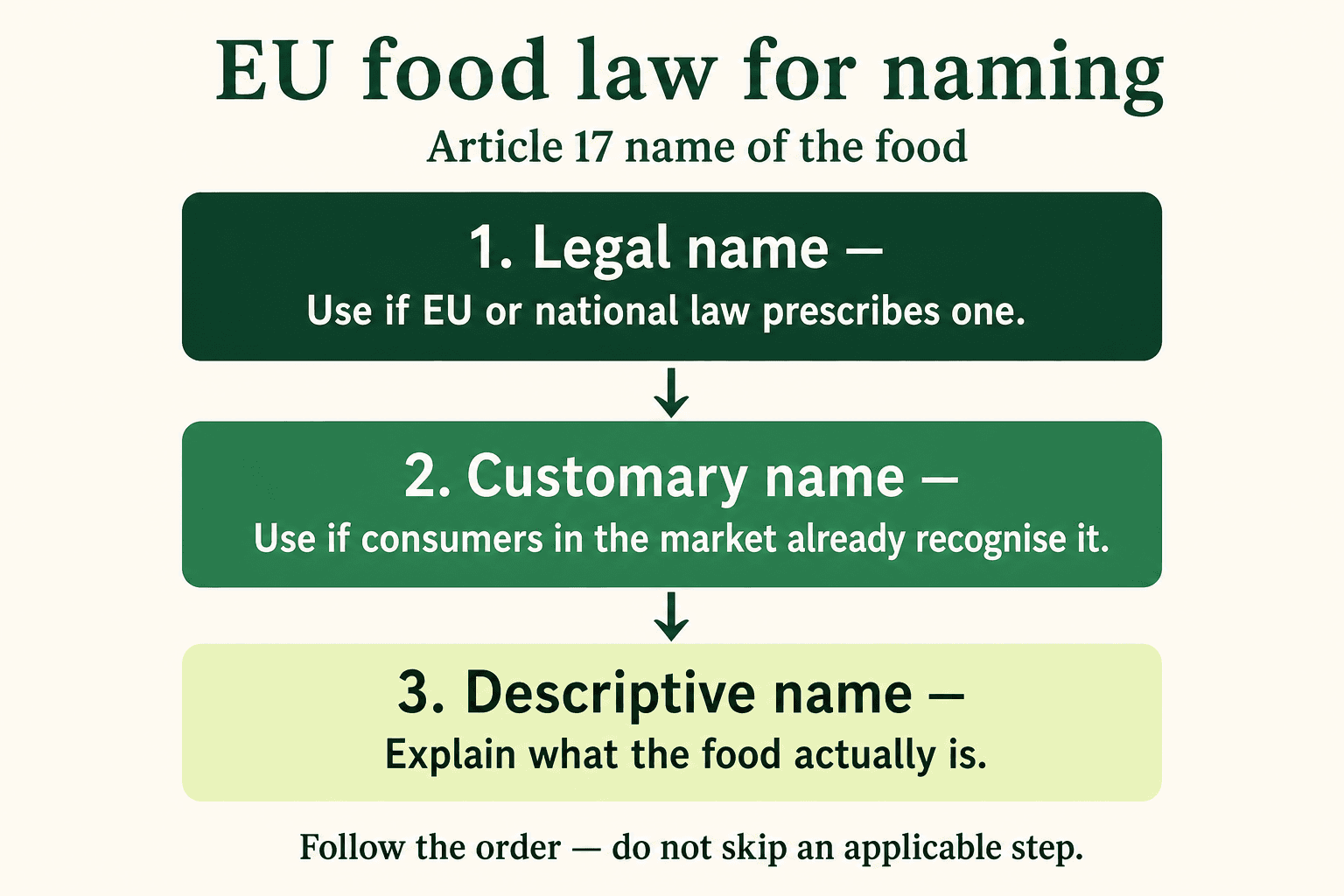
EU food law recognises three possible categories, but the product does not need to use all three. It needs one official name of the food, selected according to the order established in Article 17 of Regulation (EU) No 1169/2011:
- Use the product’s legal name where one is prescribed.
- If no legal name exists, use its customary name.
- If there is no suitable customary name—or the company does not use it—provide a descriptive name.
Legal name
A legal name is already prescribed for the food in EU or national legislation. If one applies, the company must use it—and the product must meet the conditions attached to it.
Take milk. A dairy brand may put a creative range name such as “Morning White” across the front of the bottle, but that wording cannot replace the applicable name of the food. EU rules define milk and reserve several dairy names for products that meet the relevant requirements. They also define categories such as whole, semi-skimmed and skimmed milk. The rules are set out in Regulation (EU) No 1308/2013.
The same principle applies to categories such as honey, chocolate and fruit juice. A company cannot call a diluted fruit drink “orange juice” simply because that name is commercially stronger. It must first check whether the recipe satisfies the legal definition. If it does not, the product needs a different name.
Customary name
A customary name is one that consumers already recognise without needing the food to be explained.
“Frankfurter” is a practical example. Consumers in a market where the term is established may understand that it refers to a particular type of sausage. The company does not need to replace it with a sentence describing the product simply because “Frankfurter” is not its legal name. The Food Safety Authority of Ireland uses Frankfurter as an example of a customary name.
The important part is consumer recognition in the country where the food will be sold. A name used every day by a German product team may not be understood in France or the Netherlands. Internal familiarity or common industry language is not enough. Before relying on a customary name, check whether ordinary consumers in each target market would know what food they were buying without further explanation.
Descriptive name
When there is no applicable legal or customary name, the product needs a descriptive name.
The description must be clear enough for consumers to understand the food’s true nature and distinguish it from products with which it could be confused. It should say what the product is—not repeat the brand story.
For example, “Morning Power” may be the product’s creative name. “Oat cereal with dried strawberries and almonds” would give the customer the information needed to identify the food.
Brand name and name of the food are different
Imagine a snack sold as Glow Bites. The name may be memorable, registered as a trademark and printed in enormous letters across the packaging. But it still does not tell the customer what is inside.
The label may also need wording such as “date and almond snack balls with cocoa.” Glow Bites sells the idea; the descriptive name identifies the food.
Registering the creative name as a trademark does not change that. Under Article 17 of Regulation (EU) No 1169/2011, a brand, trademark or fancy name cannot replace the required name of the food.
This becomes a problem when the creative name dominates the front while the actual food name is missing, difficult to find or inconsistent with the pictures and claims around it. Before approving the packaging, ask two separate questions: What do we want customers to remember? And will they immediately understand what food they are buying? The packaging needs to answer both.
A name can trigger other labelling decisions
Calling a product “strawberry granola” can create another labelling task: the percentage of strawberries may also need to appear on the label. This is required under the rules on QUID, or quantitative indication of ingredients, when an ingredient is included in or emphasised by the product name.
The name can also determine whether product-specific composition and labelling rules apply. Descriptions of processing or physical condition may need to appear with it. If one ingredient has been substituted for another that consumers would normally expect, Annex VI may require the substitute to be stated close to the name.
This is why the product name should be reviewed against the final recipe, specification and packaging—not approved as a standalone marketing decision. For the wider packaging checklist, see What information is required on an EU food label?.
When the product name comes with a €10,000 bill
A French charcuterie manufacturer presented ordinary sausages as “de Montbéliard”—a name protected as a geographical indication. The French consumer and food enforcement authority reported that the manufacturer paid a €10,000 transactional fine.
The problem was not a missing comma or an obscure formatting rule. The business used a valuable food name for products that did not qualify for it.
The €10,000 was the published fine. Correcting packaging, product pages, advertising and retailer information creates additional work once the name is already in use. If several products or markets share the same naming decision, the correction spreads with it.
Not every naming mistake results in the same sanction; enforcement depends on the rule, country and facts. But this case makes the commercial point clear: checking whether the product is entitled to use a name is cheaper than discovering the answer after it reaches the market.
Check the name before approving the packaging
Before signing off the product name, confirm:
- whether product-specific EU or national legislation prescribes a name;
- whether the recipe meets any conditions attached to that name;
- whether a proposed customary name is understood in each country of sale;
- whether the descriptive name clearly identifies the food;
- whether processing or physical-condition wording must accompany it;
- whether the brand name, images and claims create a misleading impression;
- whether the name triggers an ingredient percentage; and
- whether the same name works legally and linguistically in every target market.
Instead of searching through category rules and national requirements one by one, upload your label, specification or recipe to rukola. It helps identify which EU food requirements apply to the product and flags naming risks before the packaging is approved.
Review your product name with rukola
The correct name depends on the food category, final recipe, processing, packaging and countries where the product will be sold.
Upload your label, specification, recipe or website to rukola to identify applicable EU food requirements and review potential regulatory risks before launch.
rukola provides informational compliance screening based on EU food rules. It is not legal advice.
Frequently asked questions
Can a brand name replace the legal name of a food?
No. A trademark, brand name or fancy name may appear on the packaging, but it cannot replace the name of the food required by Article 17 of Regulation (EU) No 1169/2011.
What if there is no legal name for my food product?
Use its customary name if consumers in the market generally recognise one. If there is no suitable customary name—or the company does not use it—the product needs a descriptive name that explains its true nature.
Can I use the same food product name in every EU country?
Not automatically. A customary name may be understood in one country but not another, and national legal names may apply. The wording must also be provided in a language consumers in the country of sale can easily understand.
Is the product name the same as the brand name?
No. The brand identifies the product or company, while the name of the food explains what the food actually is. Both may appear on the packaging, but they perform different jobs.
Does the name have to describe how the food was processed?
Sometimes. Annex VI of Regulation (EU) No 1169/2011 requires information about the physical condition or treatment of the food when leaving it out could mislead consumers. Product-specific rules may add further requirements.
Primary sources
- Regulation (EU) No 1169/2011, Article 17 and Annex VI
- EU Court judgment explaining customary and descriptive food names
- French enforcement action involving misuse of a protected sausage name
- European Commission: Mandatory food information
Editorial note: This article was reviewed against the sources above on 24 July 2026. Product-specific EU legislation and national requirements may also apply.
This guide provides general information and does not constitute legal advice.
This guide is for general information only and does not constitute legal advice. Always verify claims against current EU and national rules for your product and market.